
Key Takeaways
- Ghana holds more UNESCO-recognized slave trade forts and castles than any other country on earth, with over 30 surviving structures along its Atlantic coast.
- The Door of No Return at Cape Coast Castle is the most emotionally significant site in the African diaspora experience, visited by millions seeking to reconnect with their history.
- Ghana is now championing a historic UN motion to formally recognize the Transatlantic Slave Trade as the gravest crime against humanity ever committed.
- The Year of Return (2019) and Beyond the Return initiative have positioned Ghana as the global center of Black diaspora homecoming, drawing over 1 million visitors in one year alone.
- The Joseph Project offers diaspora travelers DNA testing and ceremonial ancestral reconnection before and during their visit to Ghana.
- Visiting these sites is increasingly recognized as a form of ancestral healing, not simply tourism, with clinical and spiritual dimensions being studied by researchers worldwide.
- Vialis Travel offers curated roots journeys to Ghana’s heritage sites, designed specifically for diaspora travelers seeking depth, not just a tour.
Ghana has long held a quiet gravity for the African diaspora. But in 2019, that gravity became undeniable. President Nana Akufo-Addo launched the Year of Return, marking 400 years since the first enslaved Africans were documented arriving in colonial Virginia, and extended a formal invitation to the global Black diaspora to come home. More than one million people responded in that single year alone.
Now Ghana is carrying that momentum to the highest stage in the world. The Ghanaian government is championing a resolution at the United Nations to officially recognize the Transatlantic Slave Trade as the gravest crime against humanity in recorded history. Not merely a tragedy to acknowledge, but an atrocity to name, quantify, and own. It is a declaration of historical truth. And for those who carry that history in their blood and their bones, it is also something else entirely: an invitation to witness.
Ghana holds more UNESCO-listed slave trade forts and castles than any other country on earth. The soil here holds memory. And for African Americans, Black British, Afro-Caribbeans, and Afro-Europeans who have grown up with that history as an abstraction, visiting these sites is not tourism. It is something that no word quite covers.
Ghana at the United Nations: Naming the Crime
Breaking Context
Ghana is currently championing a resolution at the United Nations to formally declare the Transatlantic Slave Trade the gravest crime against humanity in recorded history. This motion represents a shift from remembrance to formal global accountability, and it is reshaping how the world understands Ghana’s role as both a site of this history and its most active advocate for justice.
For generations, the Transatlantic Slave Trade has been referenced in international frameworks as a tragedy, a dark chapter, a crime of the past. Ghana is now arguing, with growing support from across the African Union and the Caribbean community, that this framing is insufficient. What occurred between the 15th and 19th centuries was a systematic, industrialized destruction of human life and civilization. The numbers tell part of the story: an estimated 12 to 15 million people forcibly removed from the African continent, with millions more dying during capture, the march to the coast, and the brutal crossing of the Atlantic known as the Middle Passage.
Ghana’s position is grounded in a hard truth: the country is uniquely placed to make this argument. Its coastline contains more surviving slave trade fortifications than any other nation on earth. The architecture of that crime still stands here. The dungeons still exist. The doors are still open. And when Ghana speaks at the United Nations about the gravity of what happened, it does so not from a distance, but from the precise geography where it occurred.
This motion matters for diaspora travelers because it changes the context of a visit to Ghana’s heritage sites. Coming to Cape Coast Castle or Elmina Castle in 2026 is not an act of passive remembrance. It is a statement of presence at a moment when the world is being asked to formally reckon with what was done.
Understanding the Transatlantic Slave Trade: What Happened on Ghana’s Coast
To understand why Ghana matters for heritage travel, you first need to understand what happened here and why this specific stretch of Atlantic coastline became the epicenter of one of history’s greatest crimes.
The Transatlantic Slave Trade operated at scale for approximately 400 years, from the mid-15th century through the mid-19th century. It was not a single event but an industrial system involving European nations including Portugal, Britain, the Netherlands, France, Denmark, and Spain, operating across three continents in what historians call the Triangular Trade.
The Triangle Trade and Ghana’s Role
The Triangular Trade worked as follows: European ships arrived on the West African coast carrying manufactured goods - textiles, firearms, alcohol, metal goods. These were exchanged with African coastal kingdoms and traders for enslaved people, who had typically been captured in raids or wars in the interior of the continent. Enslaved people were then transported across the Atlantic in conditions of deliberate brutality on the Middle Passage. Those who survived the crossing were sold in the Americas and Caribbean, where they were forced to labor on plantations producing sugar, cotton, tobacco, and other goods that were then shipped back to Europe, completing the triangle.
Ghana’s central stretch of coastline, known historically as the Gold Coast, became the primary hub for this trade in West Africa. The Portuguese were the first Europeans to establish a permanent presence, constructing Elmina Castle in 1482. Over the following centuries, the Dutch, British, Danes, Swedes, and Brandenburgers all competed for control of the Gold Coast trade, constructing forts and castles at regular intervals along the coast. At its peak, the coast held over 40 active European fortifications. More than 30 survive today.
It is estimated that at least one third of all enslaved Africans transported across the Atlantic during the entire history of the Transatlantic Slave Trade passed through the dungeons of Ghana’s coastal forts and castles.
It is estimated that at least one third of all Africans transported through the Transatlantic Slave Trade passed through Ghana’s coastal forts and castles. That is between 4 and 5 million human beings, all through this single stretch of Atlantic coastline.
The Role of African Kingdoms
A complete and honest understanding of the slave trade history of Ghana includes a difficult truth: some African kingdoms, including the powerful Ashanti Kingdom of the interior, were at various points both victims and participants in the trade. Ashanti rulers conducted wars that produced captives who were then sold to European traders at the coast. This is not a detail to skip over. For diaspora travelers, understanding this complexity is part of what makes the journey to Ghana so much more than a simple narrative of heroes and villains. It is an encounter with history in its full, uncomfortable, necessary honesty.
Many Ghanaian guides and cultural leaders are deeply aware of this dimension and will address it directly during heritage tours. A visit to the Ashanti capital of Kumasi, included in Vialis Travel’s longer itineraries, gives diaspora travelers the chance to understand this history in conversation with the communities who have lived inside it for generations.
The Door of No Return: What It Means to Stand There
Cape Coast Castle sits on the Atlantic coast of Ghana, its whitewashed walls bright against the blue sky, its base worn smooth by centuries of salt air and sea. The castle was built by the Swedes in the 1650s, captured and expanded by the British, and became the primary hub of the British slave trade on the Gold Coast. For two centuries, it was one of the most important nodes in the entire Transatlantic Slave Trade system.
Beneath the castle’s bright exterior are the dungeons. At peak periods, the male dungeon held up to 1,000 enslaved people in a space designed for far fewer. There was no light, no ventilation, no sanitation. People were packed in conditions that deliberately crushed the human spirit before the body had even reached the ship. The mortality rate was catastrophic. Those who died in the dungeons were buried where they lay, under the floor. The ground at Cape Coast Castle contains the remains of uncounted thousands.
Above the male dungeon, British administrators built a church. This was not an oversight. The location was deliberate, a physical embodiment of the theological and moral gymnastics that allowed European Christian civilization to construct and maintain the slave trade without self-destruction. The governor worshipped directly above the people whose bodies he was selling. That fact does not require commentary. It requires witnessing.
“Standing at the Door of No Return, you understand something that no book has ever been able to teach you. Ghana is not a destination. It is a homecoming, and a reckoning, and a grief that finally has an address.”
Shared by diaspora travelers returning from Cape Coast Castle
The Door Itself
The Door of No Return is a small opening in the outer wall of Cape Coast Castle, at sea level, facing the Atlantic Ocean. Through this door, enslaved Africans were transferred directly onto waiting ships. Many had been held in the dungeons for months by the time they reached this point. The door was, quite literally, the last point of contact with the African continent for millions of people.
In 1998, a ceremony was held at Cape Coast Castle in which the door was officially and symbolically renamed the Door of Return, acknowledging the diaspora’s right to come back. Many diaspora visitors today participate in their own personal ceremonies at the door: reading names, pouring libations, sitting in silence, weeping. There is no correct way to be there. There is only the fact of being there, which itself is something that no generation of the diaspora could do for the four centuries between the trade and now.
Ghana’s Slave Castles and Forts: A Complete Overview
Ghana holds more UNESCO World Heritage-recognized slave trade sites than any other country on earth. Each site tells a different piece of the same story, and a comprehensive heritage journey will visit more than one. Here is what you need to know about the major sites.
Elmina Castle
BUILT 1482 - PORTUGUESE
The oldest European building in sub-Saharan Africa. Built by the Portuguese as a trading post, it became the first permanent European slave-trading facility in Africa. Captured by the Dutch in 1637 and held by them until 1872, when Britain took control. Its dungeon system, including a separate women’s dungeon, is among the most preserved and most harrowing in West Africa. The governor’s quarters were positioned directly above the women’s dungeon, with a private door providing direct access. This detail is explained on guided tours and is among the most disturbing physical facts of the entire castle.
Cape Coast Castle
BUILT 1653 - BRITISH
The primary hub of the British slave trade on the Gold Coast and the site of the Door of No Return. Originally constructed by the Swedes, expanded and controlled by the British from 1664 onward. The castle contains both male and female dungeons, a church positioned above the male dungeon, condemned cells for enslaved people who resisted, and extensive administrative quarters where British governors oversaw the trade. UNESCO designated it a World Heritage Site jointly with Elmina. The castle now houses the Cape Coast Castle Museum, considered one of the most important museums on the African continent.
Fort Apollonia
BUILT 1691 - BRITISH
Located near the town of Beyin in Ghana’s Western Region, close to the border with Ivory Coast. Fort Apollonia is one of the most intact and least visited of Ghana’s surviving slave trade fortifications. For diaspora travelers who want a contemplative, uncrowded experience, it offers a profound encounter with the history without the larger tour groups of Cape Coast and Elmina. The surrounding area includes the Amansuri wetlands, one of the most ecologically significant in West Africa.
Fort Amsterdam
BUILT 1631 - DUTCH
Located at Abandze near Cape Coast, Fort Amsterdam was originally built by the Dutch and changed hands multiple times between European powers. It sits on a promontory overlooking the Atlantic and gives a panoramic view of the same ocean that the enslaved were shipped across. The fort is less developed for tourism than the major castles, which contributes to a rawer, more direct experience of the site and its history.
Fort St. Jago
BUILT 1792 - BRITISH
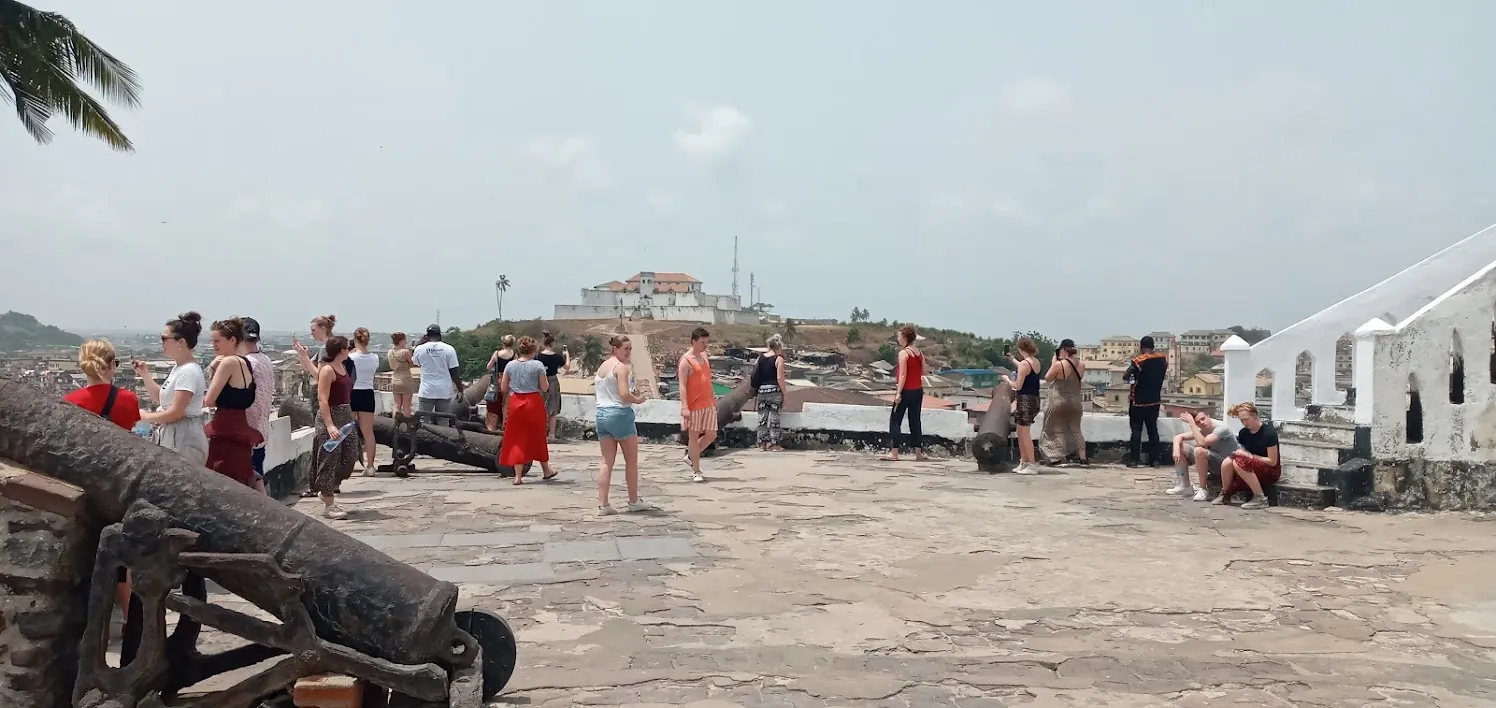
Built by the British on a hill directly overlooking Elmina Castle, Fort St. Jago (also known as Fort Coenraadsburg) was used to defend Elmina and the surrounding trade routes. Its elevated position makes it one of the most dramatic viewpoints on the entire coastline. From the top of Fort St. Jago, you can see both Elmina Castle and the open Atlantic simultaneously, which is among the most powerful visual experiences Ghana’s coast offers.
The Year of Return: How Ghana Changed Everything in 2019
On September 25, 2018, at the United Nations General Assembly in New York, Ghana’s President Nana Akufo-Addo made an announcement that would change the trajectory of African diaspora tourism permanently. He declared 2019 the Year of Return, marking the 400th anniversary of the first documented arrival of enslaved Africans in colonial Virginia, and formally invited the African diaspora to come home to Ghana.
The response was unlike anything Ghana’s tourism infrastructure had ever handled. Over one million diaspora visitors came to Ghana in 2019 alone, an increase of approximately 50 percent on the previous year. The country’s hotels, tour operators, and hospitality sector were stretched to capacity. International media coverage was extensive. The cultural conversation that followed rippled through Black communities across the United States, the United Kingdom, the Caribbean, and Europe for years afterward.
Who Came and What They Found
The Year of Return drew a remarkable cross-section of the African diaspora. Prominent figures including Cardi B, Idris Elba, Steve Harvey, Boris Kodjoe, Michael Blackson, and Naomi Campbell made public visits and shared their experiences with millions of followers. But for every celebrity who came, thousands of ordinary diaspora families came quietly, many of them traveling to Africa for the first time, many of them visiting Cape Coast and Elmina for the first time.
What they found was a welcome that many described as unlike anything they had experienced in their home countries. The Ghanaian government offered Right of Abode status to members of the African diaspora, a legal mechanism allowing diaspora individuals to live and work in Ghana without a traditional residency process. Several prominent African Americans, including actress and activist Aisha Hinds and investor and entrepreneur Muneerah Nance, publicly announced their intention to relocate.
Timeline of Heritage and Return
1482 - Portuguese construct Elmina Castle, the first permanent European structure in sub-Saharan Africa, establishing what becomes the foundational node of the West African slave trade.
1653 - 1872 - Cape Coast Castle built, expanded, and operated by successive European powers. During its peak operation, the castle processes an estimated 100,000 enslaved people per decade through its dungeons.
1807 - Britain abolishes the slave trade across its empire, though enforcement is slow and the trade continues under other flags for decades afterward.
1957 - Ghana becomes the first sub-Saharan African country to gain independence from British colonial rule, under President Kwame Nkrumah, whose Pan-African vision laid the ideological foundation for the diaspora welcome that would follow.
1979 - Cape Coast Castle and Elmina Castle designated UNESCO World Heritage Sites, formalizing their status as globally significant sites of conscience and historical memory.
1998 - The Door of No Return at Cape Coast Castle is officially rededicated as the Door of Return in a ceremony acknowledging the African diaspora’s ancestral connection to Ghana and their right to come home.
2007 - PANAFEST (Pan-African Historical Theatre Festival) at Cape Coast Castle marks 200 years since the British abolition of the slave trade. Thousands of diaspora visitors attend, many experiencing Ghana’s heritage sites for the first time.
2019 - Ghana’s Year of Return draws over 1 million diaspora visitors. President Akufo-Addo offers Right of Abode to African diaspora members. Ghana becomes the global center of Black diaspora homecoming.
2020 to present - Beyond the Return initiative launches, extending the invitation indefinitely and expanding the focus to diaspora investment, cultural exchange, and sustainable engagement with Ghana’s heritage sites.
2026 - Ghana champions a UN resolution to formally recognize the Transatlantic Slave Trade as the gravest crime against humanity in recorded history, elevating the global political context of every heritage visit to Ghana’s castles.
Beyond the Return: The Invitation That Does Not Expire
Recognizing that a single year could not contain the depth of what was being offered, Ghana launched Beyond the Return in 2020, a multi-year, multi-sector initiative designed to build on the momentum of 2019. Beyond the Return encompasses diaspora investment programs, cultural exchange partnerships, an expanded right of abode framework, heritage tourism infrastructure development, and an ongoing invitation to the global African diaspora to treat Ghana not as a destination to visit once but as a homeland to return to repeatedly.
The program operates under the understanding that the connection between Ghana and the diaspora is not a one-time event. It is an ongoing relationship that benefits both sides: the diaspora gains access to ancestry, culture, and a sense of belonging that centuries of forced separation have made difficult to access elsewhere. Ghana gains investment, cultural energy, and a reconnection with communities that share its history and its future.
The Joseph Project: Reconnecting to Your Specific Ancestors
One of the most remarkable developments in Ghana’s diaspora heritage tourism is the Joseph Project, a government initiative named after the biblical story of Joseph, who was sold into slavery by his brothers and later reunited with his family. The project uses modern DNA testing to help diaspora visitors trace their specific ethnic and geographic origins on the African continent.
The process typically begins before a traveler arrives in Ghana. A DNA test is taken, and the results are cross-referenced with the genetic profiles of Ghana’s major ethnic groups, including the Ashanti, Fante, Ewe, Ga, and Dagomba peoples. When a match is identified, the traveler can be formally received by the specific community that shares their ancestry, with cultural ceremonies, the assignment of a Ghanaian name, and in many cases a meeting with community leaders or a chief.
The emotional dimension of this experience is difficult to overstate. For African Americans especially, whose ancestral records were systematically destroyed by the institution of slavery, the ability to be told, with scientific and cultural specificity, “you come from here” and “these are your people” is something that many describe as life-altering. Several diaspora visitors who have gone through the Joseph Project process have subsequently relocated to Ghana or established regular return visits as part of an ongoing relationship with their ancestral community.
The Joseph Project pairs modern DNA testing with traditional Ghanaian hospitality and ceremony, allowing diaspora visitors to be formally welcomed into their specific ancestral ethnic community, complete with a Ghanaian name and, in many cases, a reception by the local chief.
W.E.B. Du Bois, Pan-Africanism, and Ghana’s Diasporic Roots
No account of Ghana’s relationship with the African diaspora is complete without W.E.B. Du Bois, the American sociologist, historian, civil rights activist, and one of the most important intellectuals of the 20th century. Du Bois was born in Massachusetts in 1868 and spent his life fighting for Black civil rights in America. In 1961, at the age of 93, he accepted President Kwame Nkrumah’s invitation to move to Ghana. He died in Accra on August 27, 1963, the day before the March on Washington.
Du Bois is buried in Accra, and his home has been converted into the W.E.B. Du Bois Center for Pan African Culture, one of the most significant cultural sites in the city. The center holds his personal library, documents, and memorabilia, and functions as a living memorial to the idea that Black freedom and African freedom were always one cause. For diaspora visitors to Ghana, a visit to the Du Bois Center is a profound complement to the historical weight of the slave castles on the coast.
Ghana’s embrace of Du Bois was not incidental. It was an expression of the Pan-African vision that Nkrumah built the country’s post-independence identity around: the idea that Ghana’s liberation was incomplete without the liberation of Black people everywhere, and that the African continent was the rightful home of all people of African descent, wherever the slave trade had scattered them.
PANAFEST and the Living Culture of Heritage at Cape Coast
Every two years, Cape Coast hosts PANAFEST, the Pan-African Historical Theatre Festival, one of the most significant gatherings of the African diaspora on the continent. The festival takes place at Cape Coast Castle and in the surrounding town, combining performances, academic conferences, cultural exhibitions, spiritual ceremonies, and community events that bring together diaspora visitors from across the world with Ghanaians from every region of the country.
PANAFEST was founded in 1992 with an explicit commitment to cultural reconnection and the healing of the wounds of the slave trade. It includes ceremonies at the Door of No Return, theatrical performances that dramatize the history of the slave trade, panel discussions on reparations and historical accountability, and a communal spirit that many attendees describe as unlike any cultural event they have ever experienced.
The Emancipation Day ceremony, held on August 1st at Cape Coast Castle, is the emotional climax of the PANAFEST cycle. It commemorates the abolition of slavery in the British Empire in 1834 and brings together Ghanaian leaders, international dignitaries, and diaspora visitors for a ceremony at the Door of No Return that many attendees describe as the most powerful experience of their lives.
A Complete Roots Journey: What to Experience Beyond the Castles
The castles and forts are the heart of Ghana’s heritage tourism. But a roots journey that stops only at the coast is an incomplete one. Ghana offers layers of historical, cultural, and natural experience that compound and deepen the meaning of the heritage sites. Here is what a complete diaspora journey to Ghana includes:
Accra: The Living City
Ghana’s capital offers its own essential chapter of the diaspora story. The W.E.B. Du Bois Center for Pan African Culture, described above, is a mandatory visit. The National Museum of Ghana holds artifacts spanning the entire arc of Ghanaian history, including the slave trade era and the pre-colonial kingdoms that preceded it. The Arts Centre in the heart of Accra is one of West Africa’s largest craft markets, where diaspora visitors will find Kente cloth, Adinkra symbols, wood carvings, and traditional Ghanaian art that connects directly to the visual and cultural traditions that survived the Middle Passage in fragments across the Americas and Caribbean.
Accra’s music and nightlife scene is one of the most vibrant in Africa, with Afrobeats, highlife, and gospel woven into the texture of daily life. For diaspora visitors who feel the echo of African musical tradition in the jazz, soul, reggae, and hip-hop of their home cultures, Accra’s streets offer a living, breathing demonstration of the cultural thread that survived four centuries of forced separation.
The Ashanti Region: Kumasi and the Complexity of History
Kumasi, the capital of the Ashanti Region and the seat of the Ashanti Kingdom, is a two-hour drive from Accra and one of the most culturally significant cities in West Africa. The Manhyia Palace Museum tells the story of the Ashanti Kingdom, one of the most powerful in African history, which resisted British colonization through multiple wars before finally being annexed in 1901. The Kejetia Market, one of the largest open-air markets in West Africa, is a sensory immersion in the daily commercial life that has continued in Kumasi for centuries.
The Kente-weaving villages around Kumasi offer diaspora visitors something specifically powerful: the direct visual connection between the iconic woven cloth of the Ashanti and the Kente that has become one of the most recognized symbols of Black cultural identity across the Americas, worn at graduations, funerals, church services, and celebrations throughout the African diaspora. Watching a master weaver create Kente on a traditional loom, and understanding that this tradition survived the slave trade intact on one side of the Atlantic while inspiring entirely new traditions on the other, is one of the more quietly profound moments a heritage journey to Ghana can offer.
The Volta Region: Lake Volta and the Interior Routes
Lake Volta, the largest man-made lake in the world by surface area, sits in Ghana’s eastern Volta Region. This area, bordering Togo, is one of the least-visited but most historically layered parts of Ghana. The Volta Region was a corridor for inland slave-trading routes, and many of its communities have preserved oral histories of the trade that are not documented anywhere else. For diaspora travelers interested in understanding the geography of the trade from the interior perspective rather than the coastal one, this region offers a rare and important encounter.
Ghana’s Atlantic Coastline: Confronting Beauty and History Simultaneously
The same ocean that carried enslaved people away from Ghana is staggeringly beautiful. The Atlantic coast between Accra and Takoradi, where the major castles are concentrated, is lined with fishing villages, palm trees, and beaches of white and dark sand. Local fishing communities have been here for centuries, their practices and traditions almost unchanged. The contrast between the beauty of the coast and the horror of its history is not a contradiction to be resolved. It is a tension to be held, and it is part of what makes Ghana such a profound place to visit. Both things are true here simultaneously, in a way that demands a deeper engagement than most travel ever asks of you.
Roots Travel as Healing: What Research Is Finding
The term “heritage trauma” has entered the clinical and academic mainstream in recent decades, describing the way that historical traumas, including the Transatlantic Slave Trade, are carried in the bodies, psychologies, and cultural identities of descendant communities. Increasingly, researchers in psychology, sociology, and cultural studies are examining what happens when descendants visit the sites of those historical traumas.
The early findings are consistent with what diaspora travelers have reported anecdotally for decades. Visiting Ghana’s slave trade sites, particularly with knowledgeable guides who present the history with full honesty, tends to produce a specific kind of emotional and psychological shift. Many visitors describe it as the transformation of a diffuse, inherited grief into something with a specific geography. The history stops being abstract. It has an address. It has a smell. It has a stone floor and an iron ring embedded in a dungeon wall.
Several diaspora visitors and travel writers have described the experience of weeping in the dungeons of Cape Coast or Elmina and emerging with something that, paradoxically, felt like relief. The grief was not new. But for the first time, it had a place to land.
“Akwaaba. Welcome. This is what Ghana says to the diaspora, without condition and without limitation. You belong here. You always did. The door is open.”
Traditional Ghanaian welcome extended to diaspora travelers
Practical Information for Diaspora Travelers to Ghana
Best Time to Visit
November through April is Ghana’s dry season and the most comfortable time for heritage travel. The coast is accessible year-round, but the harmattan season (December to February) brings dry, dusty winds from the Sahara that can affect visibility. The rainy season (May to October) brings lush green landscapes and fewer tourists.
Note: Due to global warming, the seasons do change.
Visa and Entry
Most diaspora travelers from the United States, United Kingdom, Canada, and the Caribbean require a visa to enter Ghana, which can be obtained in advance or as a pre-arranged visa upon arrival in Accra. The Right of Abode program offers a special residency pathway for members of the African diaspora. Vialis Travel can advise on current entry requirements.
Emotional Preparation
Seasoned guides and diaspora travel specialists consistently recommend spending time before your trip learning about the specific sites you will visit. The experience of the dungeons at Cape Coast and Elmina is significantly deeper when you arrive with historical context. Vialis Travel provides pre-trip reading recommendations as part of all heritage packages.
What to Expect
Ghana is one of the most politically stable and welcoming countries in West Africa. English is the official language. The Ghanaian cedi is the local currency. The food is extraordinary. The people are famously warm. Diaspora visitors routinely report feeling safer and more welcomed in Ghana than they expected. The word you will hear most often is Akwaaba: welcome.
Currency and Budget
Ghana uses the Ghanaian Cedi (GHS). US dollars, British pounds, and euros are widely accepted at major hotels and tourist sites. ATMs are available in Accra, Cape Coast, and Kumasi. Daily budget tiers:
- Budget: $50 to $80 per day
- Comfortable: $85 to $150 per day
- Luxury: $160 to $360 per day
Vialis Travel’s curated packages include accommodation, transfers, and guide fees in the listed price.
Health and Safety
Ghana requires proof of yellow fever vaccination for entry. Malaria prophylaxis is strongly recommended for the coastal and interior regions. Accra, Cape Coast, and Kumasi are safe for diaspora travelers. Vialis Travel partners with vetted local guides and accommodation providers at every destination on all itineraries.
Plan Your Roots Journey with Vialis Travel
Vialis Travel is a Ghana-based travel agency with deep expertise in both the logistics and the soul of this kind of journey. Their team has guided diaspora travelers from the United States, United Kingdom, the Caribbean, and across Europe through Ghana’s heritage sites with the care and depth this experience deserves. These are not generic Africa packages. They are carefully constructed itineraries for travelers who need more than a hotel and a highlight reel.
Prices from 2 pax
| Tour | Duration | Price | Best For |
|---|---|---|---|
| Cultural and Coastal Tour | 7 Days | $2,335 | The ideal first roots journey. Cape Coast Castle, Elmina Castle, Accra cultural sites, and guided heritage interpretation throughout. |
| Ghana Beach, History and Nature | 7 Days | $2,195 | Heritage combined with Ghana’s natural coastline, fishing villages, and Atlantic landscape. For travelers who want the history alongside the land itself. |
| Ghana Highlights | 3 Days | $980 | A focused introduction for travelers with limited time. Covers the most essential heritage and cultural sites in Accra and the coast. |
| Explore the Heart of Ghana | 12 Days | $3,955 | Total immersion. The coast, Accra, the Ashanti region, Kumasi, and interior Ghana. The deepest, most comprehensive roots experience Vialis offers. Ideal for those doing the Joseph Project DNA ancestry program. |
All Vialis Travel heritage itineraries include knowledgeable local guides with specific expertise in the history of the slave trade and the diaspora experience. Custom itineraries can be built around the Joseph Project DNA ancestry program, PANAFEST attendance, or Emancipation Day ceremonies at Cape Coast Castle. Contact Vialis Travel to design a journey that fits your specific needs.
Your Questions Answered
What is the Door of No Return at Cape Coast Castle?
The Door of No Return is a doorway in the outer wall of Cape Coast Castle on Ghana’s Atlantic coast, at sea level, through which enslaved Africans were transferred directly onto waiting slave ships. It represents the final point of contact between millions of enslaved people and the African continent before the Middle Passage. In 1998, the door was officially and symbolically rededicated as the Door of Return, acknowledging the African diaspora’s right to come back. Today it is the most visited and most emotionally significant site on Ghana’s heritage coast, with diaspora visitors from around the world participating in personal ceremonies of remembrance and reconnection.
What is Ghana’s Year of Return and why does it matter?
Ghana’s Year of Return was a government initiative launched by President Nana Akufo-Addo in 2019, marking 400 years since the first documented arrival of enslaved Africans in colonial Virginia. The initiative formally invited the global African diaspora - including African Americans, Black British, Afro-Caribbeans, and Afro-Europeans - to return to Ghana as their ancestral homeland. It generated over 1 million diaspora visitors in a single year and fundamentally repositioned Ghana as the global center of Black diaspora homecoming. The initiative was followed by Beyond the Return, a multi-year program that keeps the invitation open indefinitely.
How many slave castles and forts does Ghana have?
Ghana has more than 30 surviving slave trade forts and castles along its Atlantic coastline, more than any other country on earth. These structures were built by Portugal, Britain, the Netherlands, Denmark, Sweden, and Brandenburg (Germany) between the late 15th and 18th centuries. The most significant are Cape Coast Castle and Elmina Castle, jointly designated a UNESCO World Heritage Site. Other important sites include Fort Apollonia, Fort Amsterdam, Fort St. Jago, and Fort Metal Cross. Together, these structures form the most concentrated collection of slave trade architecture anywhere in the world.
What is the Joseph Project and how does it help diaspora travelers?
The Joseph Project is a Ghanaian government heritage initiative that uses modern DNA testing to help African diaspora visitors trace their specific ethnic and geographic origins within Ghana. The project is named after the biblical story of Joseph, who was sold into slavery by his brothers and later reunited with his family. Travelers take a DNA test before arriving in Ghana, and results are cross-referenced with the genetic profiles of Ghana’s major ethnic groups, including the Ashanti, Fante, Ewe, Ga, and Dagomba peoples. Matched travelers can then be formally received by their ancestral community with traditional ceremonies and the assignment of a Ghanaian name. For African Americans whose ancestral records were destroyed by slavery, the Joseph Project offers a form of ancestral reconnection that is both scientifically grounded and culturally meaningful.
Is Ghana safe for African American and Black diaspora travelers?
Yes. Ghana is consistently ranked as one of the most politically stable and safest countries in West Africa, and is widely regarded as one of the most welcoming destinations for African diaspora travelers on the continent. Diaspora visitors from the United States, United Kingdom, and Caribbean routinely report feeling a profound sense of safety, belonging, and welcome that they describe as unlike their experiences at home. English is the official language. The Ghanaian government has invested significantly in diaspora-friendly infrastructure, including right of abode provisions, diaspora investment programs, and heritage tourism development. Crime targeting tourists is rare, and Vialis Travel’s guided itineraries use vetted local partners throughout.
What is PANAFEST and when does it take place?
PANAFEST, the Pan-African Historical Theatre Festival, is a biennial cultural festival held at Cape Coast Castle and in the surrounding town of Cape Coast, Ghana. Founded in 1992, it is one of the most significant gatherings of the African diaspora on the African continent. The festival combines theatrical performances, academic conferences, cultural exhibitions, traditional ceremonies, and community events, culminating in the Emancipation Day ceremony on August 1st at the Door of No Return. PANAFEST draws diaspora visitors from the United States, United Kingdom, Caribbean, and across the world. Vialis Travel can build itineraries around PANAFEST attendance for travelers who want to combine their heritage visit with this extraordinary cultural event.