
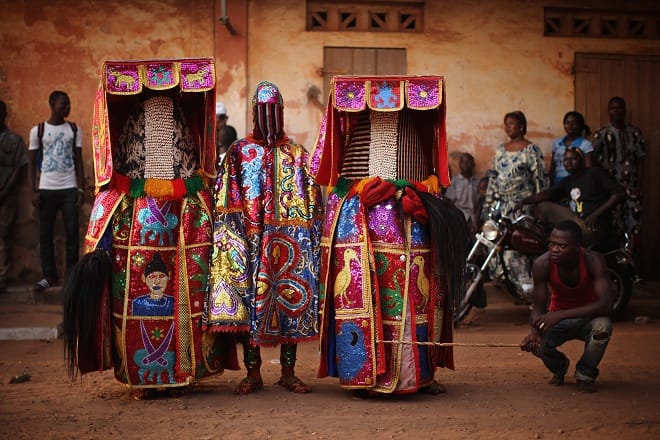
The Benin Voodoo Festival, known locally as Vodun Days, is held every January 10 in the coastal town of Ouidah, with related events typically running from January 8 through 10. It is Benin’s national day honoring Vodun, the traditional religion practiced by roughly 20 to 30 percent of Beninese people and recognized as an official national religion since 1996. Tourists are welcome to attend the public ceremonies, which include drumming, dancing, and processions through Ouidah’s historic sites, making it one of West Africa’s most distinctive cultural events to plan a trip around.
- The main festival day is January 10 each year, with Vodun Days events running January 8 to 10 in Ouidah.
- Vodun (Voodoo) originated in this region and has been an officially recognized religion in Benin since 1996.
- Public ceremonies are open to tourists, though some rites are reserved for initiates and should not be photographed without permission.
- Ouidah’s other Vodun heritage sites, the Python Temple, the Sacred Forest of Kpasse, and the Door of No Return, can be visited any time of year, not only during the festival.
Jump to: What is the Benin Voodoo Festival | When it happens | What to expect at Vodun Days | Respectful visiting etiquette | Other Vodun heritage sites in Ouidah | FAQ
What is the Benin Voodoo Festival?
Vodun, often anglicized as “Voodoo,” is a traditional West African religion that originated among the Fon and Ewe peoples of what is now Benin and Togo, later spreading through the transatlantic slave trade to Haiti, Louisiana, and Brazil, where it evolved into related but distinct traditions. Benin has recognized Vodun as an official national religion since 1996, and the government has organized an international festival around it for roughly three years running, centered on the practice’s spiritual home in Ouidah.
When does the Benin Voodoo Festival happen?
The main festival date is January 10 every year, a national holiday in Benin. The broader Vodun Days program of related ceremonies and cultural events typically runs from January 8 through January 10 in Ouidah. Because the core date is fixed on the calendar (rather than lunar or clan-based like some Ghanaian festivals), it is easier to plan travel around with confidence, though we recommend confirming the exact program dates with us before booking, since the surrounding multi-day schedule can shift slightly year to year.
What to expect at Vodun Days
- Drumming and dance processions: Practitioners in elaborate costumes move through Ouidah’s streets and historic sites, often in a trance state understood within the tradition as spirit possession.
- Public ceremonies at sacred sites: Events center on locations including the Python Temple and the Sacred Forest of Kpasse, both open to respectful visitors.
- Large crowds: Ouidah’s population swells considerably for the festival, with Beninese Vodun practitioners, diaspora visitors from Haiti and Brazil, and international tourists all attending.
- A mix of solemn and celebratory moments: Some rites are quiet and reserved for initiates; others are loud, public, and performative. A local guide helps you understand which is which as the day unfolds.
Visiting respectfully
Vodun is a living religion, not a tourist performance, and visitors should treat it accordingly:
- Always ask before photographing individuals, ceremonies, or sacred objects; some rites are closed to photography entirely.
- Dress modestly and follow your guide’s direction on where tourists may and may not stand during specific ceremonies.
- Do not touch shrines, altars, or ceremonial objects.
- Approach the event with the same respect you would bring to any religious ceremony, since for many attendees this is exactly that.
Traveling with a guide who has existing relationships in Ouidah, as our Benin Voodoo Festival 12-Day trip does, makes a meaningful difference in both access and appropriate conduct during the festival.
Other Vodun heritage sites in Ouidah (year-round)
| Site | What it is |
|---|---|
| Temple of the Pythons | A working Vodun temple housing royal pythons considered sacred; visitors can view and, with permission, handle the temple’s pythons |
| Sacred Forest of Kpasse | A forest sanctuary with statues representing Vodun deities, tied to the founding legend of Ouidah |
| Door of No Return, Ouidah | A memorial arch marking the route enslaved people walked to the coast, similar in purpose to Ghana’s Cape Coast site |
| Ouidah Museum of History | Housed in the former Portuguese Fort Sao Joao Baptista de Ajuda, covering the slave trade and Vodun heritage together |
These sites can be visited outside festival season as part of our 8-Day Uncover the Beauty of Benin itinerary, which also covers Abomey’s royal palaces and Ganvie’s stilt village, if your travel dates do not line up with January.
Getting to Ouidah for the festival
Ouidah sits roughly 42 kilometers (26 miles) west of Cotonou, Benin’s largest city and main international gateway, a drive of about 45 minutes to an hour outside festival-day traffic. Most international flights route through Cotonou’s airport, making it the natural arrival point for a Vodun Days trip. Because the festival draws large crowds into a relatively small town, accommodation in Ouidah itself books up months in advance; many visitors instead base themselves in Cotonou and travel to Ouidah for the day, an approach our Benin Voodoo Festival 12-Day itinerary builds in as a planned option alongside overnight stays closer to the festival grounds.
If you are combining Benin with a Ghana trip, note that Accra to Cotonou is not a short hop. There is no direct land border crossing between Ghana and Benin (Togo sits between them), so most travelers fly between the two countries or route through Togo by road. Plan Ghana and Benin as two distinct legs of your trip rather than an easy same-week add-on.
Frequently asked questions
When is the Benin Voodoo Festival?
The main festival day is January 10 every year, a national holiday in Benin. The broader Vodun Days program of ceremonies in Ouidah typically runs from January 8 through 10.
Is the Voodoo Festival open to tourists?
Yes. Public ceremonies and processions are open to respectful visitors, though some rites are reserved for initiates and should not be approached or photographed without explicit permission from organizers or your guide.
Is Vodun the same as Hollywood-style “voodoo”?
No. Vodun is a structured, officially recognized religion in Benin with its own theology, priesthood, and ethical code. It bears little resemblance to the horror-genre “voodoo” stereotype common in Western film and media, and visitors should approach it as a genuine faith tradition.
What should I wear or bring to the festival?
Modest clothing, comfortable closed-toe shoes for standing in crowds, and a hat or head covering for sun protection are recommended. Leave expensive jewelry at your hotel given the crowd density, and bring cash in small cedi or CFA franc denominations for local vendors.